
Medicaid Rehab Coverage: What It Pays for by State
What “Medically Reviewed” means
Pages carrying the Medically Reviewed badge have been reviewed for accuracy by credentialed medical professionals and specialists. The Medical Reviewer and the review dates appear at the bottom of the page.
The Treatment Community is physician-led and editorially independent. We fact-check against strict guidelines and cite only credible sources — peer-reviewed research and government health agencies — and re-review each page on a six-month cadence, or sooner when clinical guidance changes.
Written by TTC Editorial Team · Medical Reviewer: Dr. Adiele Onyeze, MD · Independent and physician-led · How we review
TTC is editorially independent. Some links on this page may be affiliate links; if you use one, TTC may earn a commission at no cost to you. This never affects our physician-reviewed guidance. Read our FTC disclosure.
This guide covers Medicaid alcohol treatment coverage: what Medicaid typically pays for, why the answer changes by state and plan, and how to confirm your own benefits before you contact any program.
Usually yes. Medicaid typically covers treatment for alcohol use disorder at several levels of care, and many state formularies (covered-drug lists) include the FDA-approved medications. Medicaid treatment coverage varies by state and plan — which services, whether prior authorization is needed, and how long a stay is approved — so start with a benefits check with your plan or state Medicaid agency.
Key Takeaways
- Federal parity rules apply to most Medicaid managed care plans, so Medicaid treatment coverage limits generally cannot be stricter than for medical care.
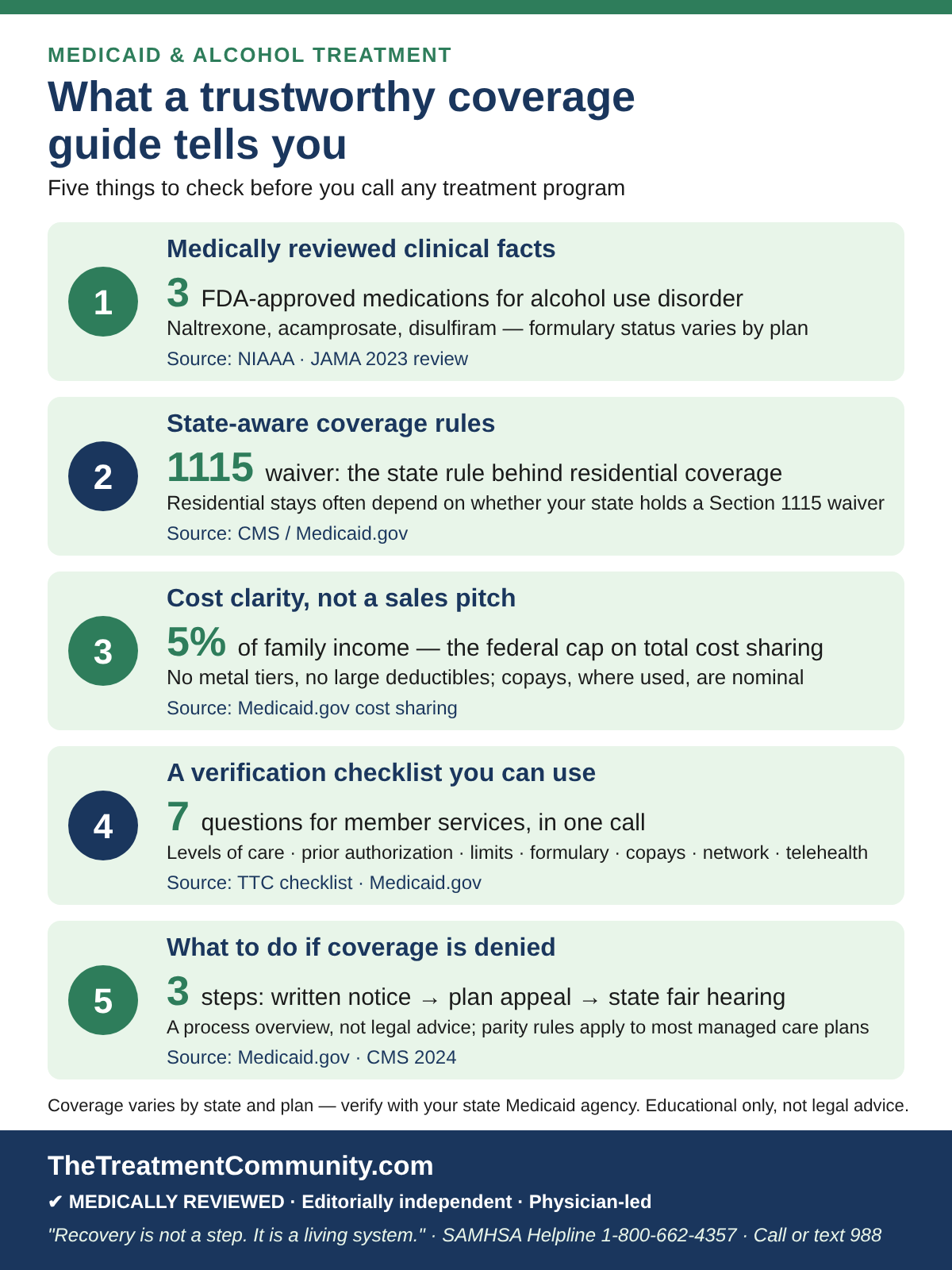
- Medicaid has no metal tiers or large deductibles; copays, where they exist, are nominal and capped by federal rules.
- Residential coverage often depends on whether your state holds a Section 1115 substance use disorder waiver.
- There is no universal day limit; how much treatment Medicaid covers is decided by medical necessity and your plan’s rules.
- A denial is not final: enrollees generally have a right to written notice, an appeal, and a state fair hearing.
If you need to talk to someone now: SAMHSA National Helpline 1-800-662-4357 (free, confidential, 24/7) or call or text 988. More crisis resources.
Table of Contents
Does Medicaid Cover Alcohol Treatment? The Short Answer
Why parity rules make Medicaid a mainstream route to care, and what this page does not do.
Myth: using Medicaid means settling for second-rate alcohol treatment. In practice, the Mental Health Parity and Addiction Equity Act applies to most Medicaid managed care plans. Under parity, copays and treatment limits for substance use disorder benefits generally cannot be more restrictive than for medical care1. Medicaid is a major payer for substance use disorder treatment — a mainstream route to care. The same clinical levels of care are used regardless of payer, and three medications are FDA-approved for alcohol use disorder2. What differs in Medicaid treatment coverage is the state and the plan.
Two limits, stated plainly. This page does not determine eligibility and is not legal advice; a caseworker, your state agency, or a qualified professional can help with that. Physical, cardiac, or skilled-nursing rehabilitation is a separate Medicaid benefit category; Medicaid.gov is the place to look for those. If you would rather talk than read, SAMHSA’s helpline is free, confidential, and open 24/73.
What Medicaid Typically Covers: Withdrawal Management, Inpatient, Outpatient, and Medication
The levels of care most plans recognize, and how medication coverage is decided.
Medicaid covers alcohol treatment at several levels of care. Most plans organize them using the ASAM Criteria, the same framework clinicians use in medical-necessity reviews4. The levels run from medically supervised withdrawal management through residential care, partial hospitalization, intensive outpatient, outpatient counseling, and ongoing medication management. Medical necessity means the plan’s judgment that a service is clinically needed; prior authorization is the plan’s approval before a service is covered. The grid below summarizes Medicaid treatment coverage by category — a reading aid, not a promise of coverage.
| Service | Commonly covered | Often needs prior authorization | Varies most by state |
|---|---|---|---|
| Medically supervised withdrawal management | Yes, in many plans | Sometimes | Setting (hospital vs. freestanding) |
| Residential / inpatient treatment | Depends on state waiver | Usually | Yes — see Section 1115 below |
| Partial hospitalization and intensive outpatient | Yes, in many plans | Often | Visit limits and review cadence |
| Outpatient counseling | Yes, in many plans | Rarely at the start | Covered provider and therapy types |
| Medications for alcohol use disorder | Formulary-dependent | Sometimes (especially injectable forms) | Which forms are preferred |
If your question is what types of therapy Medicaid covers, ask your plan; individual, group, and family formats and covered provider types differ by plan.
On medication: naltrexone (including an extended-release injectable form), acamprosate, and disulfiram are the FDA-approved options for alcohol use disorder2. A 2023 systematic review in JAMA found that oral naltrexone and acamprosate were associated with reduced return to drinking5. Medicaid coverage for medication-assisted treatment — these medications paired with counseling — comes down to formulary status: whether each drug is on your plan’s list of covered medications, and whether a given form needs prior authorization. Whether one is right for you is a conversation for a prescribing clinician; this page describes coverage only. Co-occurring mental health conditions fall under the same parity protections in most managed care plans1.
How Medicaid Treatment Coverage Varies by State and Plan Type
Three variables — delivery model, Section 1115 waivers, and expansion — explain most of the differences.
Medicaid has no bronze, silver, or gold tiers; three other variables matter instead.
Delivery model. Most states enroll adults in a managed care organization (MCO), a private plan the state pays to run benefits. Some still run fee-for-service Medicaid, where the state pays providers directly. The MCO sets its own formulary, network, and prior-authorization rules within state limits.
Section 1115 waivers. A federal rule called the IMD exclusion has long limited Medicaid payment for stays in larger residential facilities. Many states now hold a Section 1115 substance use disorder waiver, approved by CMS, that lets them cover residential treatment anyway6. So residential coverage depends on your state’s current waiver status.
Expansion. Medicaid expansion under the Affordable Care Act widened adult eligibility in participating states, which affects whether you qualify at all7. Parity rules sit on top of all three for managed care enrollees1.
Medicaid treatment coverage by state differs because each state defines its own substance use disorder benefit. Whether Medicaid covers treatment in Michigan, Texas, or through Medi-Cal in California is therefore a state-agency question; a national page can describe the structure, not the specifics.
How to Check Eligibility and Verify Your Benefits
Three neutral routes to a benefits check, and the seven questions to write down.
Three neutral routes exist for a Medicaid treatment benefits check. The first two are not sales channels. Try them in order:
- Call member services using the number on your Medicaid or MCO card. Ask for a behavioral health benefits representative.
- Contact your state Medicaid agency if you are not yet enrolled or the plan cannot answer. Eligibility rules and applications are state-run; Medicaid.gov links to each state’s agency7.
- Call a program’s admissions line last, once you know what your plan says, and compare the two answers.
Write down the answers to seven questions:
- Which levels of care and what types of therapy does Medicaid cover under my plan?
- Does each service need prior authorization?
- How much treatment does Medicaid cover before a review — are there day or visit limits, and how often is medical necessity reviewed?
- Which medications for alcohol use disorder are on the formulary, and in what forms?
- What copays apply to me?
- Is the program an enrolled, in-network provider?
- Is telehealth covered?
One call usually leaves you with written notes on authorization, limits, and expected out-of-pocket cost.
Check your Medicaid benefits with our medically reviewed verification checklist. Print or save the seven questions above, or use a verification service:
Affiliate disclosure: TTC may earn a commission if you use a partner verification service. This does not change what we recommend or how the checklist was reviewed. FTC disclosure.
Questions to Ask About Prior Authorization, Length of Stay, and Out-of-Pocket Costs
Why there is no universal day limit, and how Medicaid cost sharing differs from commercial plans.
There is no universal number of days Medicaid will pay for alcohol treatment. Length of stay is authorized based on medical necessity, reviewed periodically against clinical criteria, and bounded by your state’s and plan’s rules64. Two people with the same Medicaid treatment coverage can be approved for different stays. Individual circumstances vary, and only your plan can state your authorization.
On prior authorization, ask who submits it (usually the program), how long a decision takes, and what documentation is needed. Medicaid treatment out-of-pocket costs follow different rules than commercial plans, as the table shows.
| Cost element | How Medicaid handles it |
|---|---|
| Deductible | Generally none; states may not impose large deductibles |
| Copay | States may charge nominal copays; amounts vary by state and service |
| Coinsurance | Rare; where used it is capped at nominal levels |
| Out-of-pocket maximum | Total cost sharing is capped at 5% of family income |
| Exempt groups | Certain groups, including children and pregnant people, cannot be charged most cost sharing |
Ask the program for a written cost estimate before you commit. To weigh Medicaid treatment coverage against what each level of care costs without insurance, see our alcohol treatment cost guide; the Alcohol Savings Calculator shows what current spending on alcohol adds up to.
Prefer to work through this later? Get TTC’s medically reviewed coverage and treatment guides by email.
No sales calls. Unsubscribe anytime. See our Privacy Policy.
Finding Treatment Programs That Accept Medicaid
The neutral route to programs that take Medicaid, and the payer-neutral criteria TTC uses.
Start with FindTreatment.gov, the federal locator, and filter by payment accepted. Then confirm with your plan that the program is an enrolled, in-network provider, because a locator listing is not a network guarantee9. That is the neutral route to alcohol treatment centers that take Medicaid. TTC does not rank or endorse facilities. The criteria we use, and that NIAAA’s Alcohol Treatment Navigator recommends, are disclosed and payer-neutral: state licensing, staff credentials, evidence-based methods, access to medications for alcohol use disorder, and payment types accepted10. Our treatment directory applies those same criteria.
Whether your Medicaid treatment coverage includes telehealth counseling and medication management is a plan-level question worth asking. NIAAA notes telehealth can be an effective option for alcohol treatment and reaches people who would not attend in person11. Pregnant and postpartum people, youth (through EPSDT, Medicaid’s child and adolescent benefit), and adults enrolled in both Medicare and Medicaid may have additional benefits; your state agency can confirm, and the FAQ below covers how long Medicare will pay for you to be in inpatient treatment.
If Coverage Is Denied: Appeals and State Medicaid Resources
A denial is a process step: written notice, plan appeal, then a state fair hearing.
A denial of Medicaid treatment coverage is a process step, not the end. Managed care enrollees generally have a right to written notice of an adverse decision with the reason, an internal plan appeal, and, if needed, a state fair hearing — a formal review by the state, outside the plan12. Deadlines are printed on the notice. Non-legal help is available from your state Medicaid agency and, in many states, an ombudsman or consumer-advocate program. This is a process overview, not legal advice; a qualified advocate or attorney can advise on your case. A family member can help gather documents with your consent; our Family Alcohol Support Hub has resources for them.
Frequently Asked Questions About Medicaid Treatment Coverage
Tap a question to open its answer.
How long will Medicaid pay for rehab?
There is no set day count. Medicaid authorizes treatment based on medical necessity, reviews it periodically, and applies state and plan rules6. Individual circumstances vary; ask your plan what has been authorized and when it will be reviewed.
Will Medicaid pay for medical rehab?
Physical, cardiac, and skilled-nursing rehabilitation are separate Medicaid benefit categories with their own rules. This page covers alcohol treatment. For other rehabilitation benefits, Medicaid.gov and your state agency are the right sources.
Does Virginia Medicaid cover inpatient rehab?
Virginia’s Medicaid treatment coverage is set by the state, as every state’s is. Inpatient and residential rules, prior authorization, and limits must be confirmed with the Virginia Medicaid agency or your managed care plan. The same applies if you are asking whether Medicaid covers treatment in Michigan or any other state.
How long will Medicare allow you to stay in a rehab facility?
Medicare is a separate federal program. Medicare Part A covers inpatient hospital care under its own benefit-period and cost-sharing rules, which differ from Medicaid’s13. How long Medicare will pay for you to be in inpatient treatment follows those Part A rules. If you are enrolled in both, check both programs; Medicare.gov publishes the Part A details.
Does Medicaid cover medication for alcohol use disorder?
Often, yes. Naltrexone, acamprosate, and disulfiram are FDA-approved for alcohol use disorder2, and many state formularies list them, sometimes with prior authorization. Medicaid coverage for medication-assisted treatment is a formulary question for your specific plan. Which medication, if any, fits your situation is a decision for a prescribing clinician.
Next Steps: Verify Your Coverage Before You Call a Program
One call with the seven questions in hand leaves you with written facts.
One call to member services or your state agency, with the seven questions in hand, is a reasonable first move that leaves you with written facts rather than a sales conversation. Medicaid treatment coverage varies by state and plan; the agency confirms what applies to you. For how a commercial plan handles the same questions, see our Aetna coverage guide.
Explore Treatment & Professional Care options that list Medicaid, using neutral, disclosed criteria. Find treatment programs
Disclosure: TTC does not accept payment for inclusion or ranking in its directory. Some listed programs may be affiliate partners, which is disclosed on each listing. FTC disclosure.
“Recovery is not a step. It is a living system.”