
Sobriety Calculator: Days Sober, Milestones & Money Saved
Enter one date. See exactly how long you’ve been sober, what you’ve avoided, and what the evidence says changes next — free, private, no account. It takes about a minute.
This tool provides estimates based on published research data and is not a diagnostic instrument.
Adiele Onyeze, MD · Last reviewed November 3, 2026
Count the days — and what they add up to
A sobriety calculator does one job: it counts the whole days from your sobriety date — your first alcohol-free day — to today, and turns that number into something you can see. This one also shows your current milestone band, the days to your next milestone and, if you add a baseline, the drinks, money and calories you have avoided. The full result is free, there is no account, and nothing is held back behind an email form.
Your date and your baseline stay in your browser. The calculator runs on your device. The page counts which milestone band was shown, with no name, email or IP address; nothing else is sent unless you ask us to email your progress report. This calculator is part of The Restoration Ecosystem™, our physician-led set of tools and guides for alcohol recovery.
Counting days helps some people and not others. If a running total keeps you steady, use it. If it adds pressure, skip the count and use the milestone notes below instead. Either is fine. One standard drink here means a 12 oz regular beer, a 5 oz glass of wine or a 1.5 oz shot of spirits, each with about 14 g of pure alcohol1.
If you are in crisis or need help now: call or text 988, or call the SAMHSA National Helpline at 1-800-662-4357 — free, confidential, 24/7.
Your sobriety calculator
What it is: a day counter with a milestone schedule and arithmetic on your own baseline. What it is not: a screening test, a diagnosis or a withdrawal plan — only a licensed clinician can assess alcohol use disorder or supervise stopping. The six result bands are fixed and published below: first week, first month, one to three months, three to six months, six months to a year, and a year and beyond.
Sobriety Calculator: Days Sober, Milestones & Money Saved
Medically reviewed by Adiele Onyeze, MD · November 2026
Enter one date. See exactly how long you've been sober, what you've avoided, and what the evidence says changes next — free, private, no account.
One date in, your full result out: days sober, your current milestone band, the days to your next milestone, and — if you add a baseline — the drinks, money and calories you have avoided. Nothing here needs an account, and the result is never held back. This calculator is part of The Restoration Ecosystem™, our physician-led set of tools and guides for alcohol recovery. Counting days helps some people and not others; either is fine.
Your date and your baseline stay in your browser. The page counts which milestone band was shown — with no name, email or IP address — and nothing else leaves this page unless you ask us to email your report. If you are in crisis, call or text 988, or call the SAMHSA National Helpline at 1-800-662-4357.
- No trackers on this page
- Your date and baseline stay in your browser
- From a physician-led publisher — every milestone line has a source you can check
Your result appears here. It's free, and no email is needed to see it.
Please check your entries: the sobriety date must be today or earlier and within the last 100 years; drinks per week is a whole number from 0 to 140; the price is from $0 to $100.
- Time sober
- Days sober
- Next milestone
- Milestones reached
- Drinks avoided (from your baseline)
- Money saved (your price × drinks avoided)
- Calories avoided — an estimate, not a weight prediction
Email me my progress report and milestone reminders
How the calculator works
We count the whole calendar days from your sobriety date — your first alcohol-free day — to today, in your browser. That first day shows as 0 days; the next day is 1. Drinks avoided = days × your drinks per week ÷ 7. Money saved = drinks avoided × the price you paid per drink. We add no default price: your number is the only honest one.
Calories use the US Dietary Guidelines figures for one standard drink: about 150 for a 12 oz regular beer, 120 for a 5 oz glass of wine and 100 for a 1.5 oz shot of spirits; 'mixed or not sure' uses the average, 123. Calories are an estimate of what you didn't drink, not a prediction about your weight. This is not a weight-loss tool.
Milestones are 1 week, 30, 60, 90 days, 6 months and then each calendar anniversary — the checkpoints most recovery communities use. The schedule is ours; it is not a medical cut-off.
This tool provides estimates based on published research data and is not a diagnostic instrument. The information on TheTreatmentCommunity.com is for educational purposes only and is not a substitute for professional medical advice, diagnosis, or treatment. Always consult a qualified healthcare provider before making treatment decisions. Not a withdrawal plan: stopping heavy or long-term drinking can cause dangerous withdrawal — talk to a clinician first.
In crisis or need help now? Call or text 988 (Suicide & Crisis Lifeline), or call the SAMHSA National Helpline at 1-800-662-4357 — free, confidential, 24/7. For a seizure, a fever, severe confusion, hallucinations or an irregular heartbeat after heavy drinking, go to the emergency room or call 911.
How the calculator works
Days sober are the whole calendar days from your sobriety date to today. The sobriety date itself shows as 0 days; the next day is 1. Days change at midnight in your own time zone, and a daylight-saving change never shifts the count. For a year or more the result also shows years, months and days by calendar date.
Drinks avoided = days sober × your drinks per week ÷ 7. Money saved = drinks avoided × the price you paid per drink. We add no default price: the free government calculator takes your own price too2. Your own number is the only one that fits your spending. Calories use the US Dietary Guidelines figures for one standard drink — about 150 kcal for a 12 oz regular beer, 120 kcal for a 5 oz glass of wine and 100 kcal for a 1.5 oz shot of 80-proof spirits3; “mixed or not sure” uses the average, 123 kcal. Mixers and cocktails are not counted.
Calories are an estimate of what you didn’t drink, not a prediction about your weight. This is not a weight-loss tool.
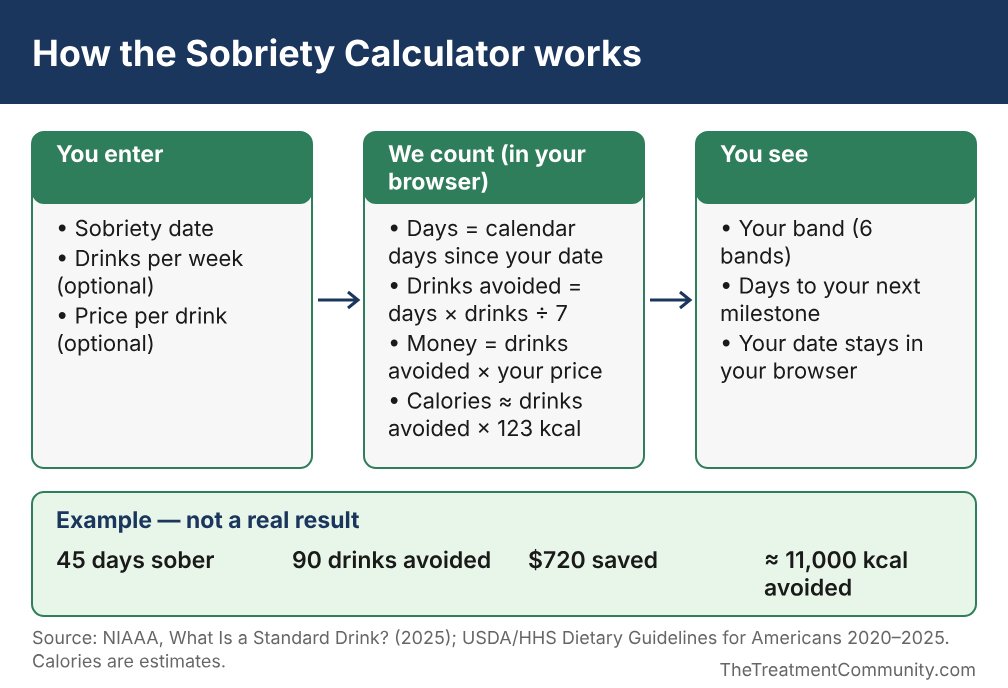
Text description of the figure
A left-to-right process flow. Panel 1 “You enter”: sobriety date (required), drinks per week and price per drink (optional, stay in your browser). Panel 2 “We count”: calendar days since your date; drinks avoided = days × drinks per week ÷ 7; money = drinks avoided × your price; calories = drinks avoided × about 123 kcal (beer 150, wine 120, spirits 100). Panel 3 “You see”: your band — first week, first month, one to three months, three to six months, six months to a year, a year and beyond — and the days to your next milestone. Example panel: 45 days sober (sobriety date = day 0), 90 drinks avoided, $720 saved, about 11,000 kcal avoided. Source line: NIAAA standard drink (2025); Dietary Guidelines for Americans 2020–2025.
Milestones are 1 week, 30 days, 60 days, 90 days, 6 months and then each calendar anniversary. They are the checkpoints most recovery communities use; the schedule is ours, and it is not a medical cut-off. The year band starts on the anniversary itself, so a count that crosses a leap day stays in the six-month band until the date comes round.
What your result means
Each band says where you are, what the next marker is and, where the evidence supports it, what the research measured. None of it is a verdict, and none of it predicts your outcome.
First week (0–6 days)
Safety first. If you drank heavily every day, withdrawal symptoms tend to begin within about 8 hours of the last drink, usually peak by 24 to 72 hours, and can go on for weeks4. A clinician can make stopping safer. Go to the emergency room or call 911 for a seizure, a fever, severe confusion, hallucinations or an irregular heartbeat4. Your next milestone is one week. If you would like a plan for the next 30 days, the recovery and wellness guides are one option.
First month (7–29 days)
One week down. The card shows your totals so far and the days to 30. There is no health claim in this band: the sourced evidence starts at the one-month mark. If you want to know what is ahead, the recovery and wellness guides cover the first weeks.
One to three months (30–89 days)
A full month. In one prospective study, 94 moderate to heavy drinkers who abstained for a month were compared with 47 who kept drinking: insulin resistance fell by a median 25.9% and systolic blood pressure by a median 6.6% in the abstaining group5. The study was not randomised and the medians come from one group, so your numbers may differ. Separately, 857 adults who took part in a month-off challenge reported drinking less six months later, whether or not they finished the month — an association among people who joined, with no comparison group of people who did not6. The 60- and 90-day marks are next.
Three to six months (90–179 days)
Ninety days and counting. The next sourced checkpoint is six months. This is often where people look at what keeps the days going — medication and telehealth options, support groups, a counsellor. They are options, not instructions.
Six months to a year (180 days to the day before your anniversary)
Half a year. NIAAA says the extent to which the brain returns to normal after long-term sobriety is not fully understood, but a growing number of studies indicate that at least some alcohol-related brain changes — and the changes in thinking, feeling and behaving that go with them — can improve and possibly reverse with months of abstinence7. The card counts down to your one-year anniversary.
A year and beyond (from the first calendar anniversary)
A year or more, counted by anniversary. Long-run changes are described in the research as treatable; no timeline is promised and no source claims a return to a pre-drinking state. The card keeps your running totals and shows the next anniversary date. Share your milestone card if you would like to.
What the evidence says changes at each milestone
The gaps are shown as gaps. Where no study marks a checkpoint, the figure says so rather than borrowing a number.

Text description of the figure
A horizontal timeline with six nodes. First week: withdrawal symptoms can start within 8 hours and peak at 24–72 hours — if you drank heavily, talk to a clinician before stopping; go to the emergency room or call 911 for a seizure, a fever, severe confusion, hallucinations or an irregular heartbeat. 30 days: in a one-month abstinence study of 94 people, insulin resistance fell by a median 25.9% and systolic blood pressure by a median 6.6% (not randomised); people who did a month-off challenge also reported drinking less six months later (an association in 857 participants, no comparison group). 60–90 days: no new sourced marker — the next sourced checkpoint is six months. 6 months: at least some alcohol-related brain changes, and the thinking, mood and behaviour changes with them, can improve and possibly reverse with months of abstinence; how far is not fully understood. 1 year: no new sourced marker — anniversaries are the checkpoint recovery communities use. Beyond: if you had heavy, long-term use, liver disease is treatable if caught before severe damage; no timeline is promised. Example marker: 45 days sober, next milestone 60 days in 15 days.
- First week. Withdrawal symptoms tend to occur within 8 hours after the last drink but can occur days later; they usually peak by 24 to 72 hours and may go on for weeks4. Withdrawal can become life-threatening: contact a provider or go to the emergency room if you may be in withdrawal after heavy, recent drinking, and call 911 for seizures, fever, severe confusion, hallucinations or an irregular heartbeat4.
- 30 days. Insulin resistance −25.9% and systolic blood pressure −6.6%, medians in 94 abstainers versus 47 controls over one month, not randomised5. A small change in weight was observed in the same study5. Month-off participants reported drinking less six months on — an association in 857 people, no comparison group6.
- 60–90 days. No new sourced marker. The next checkpoint with evidence behind it is six months.
- 6 months. At least some alcohol-related brain changes can improve and possibly reverse with months of abstinence; the extent is not fully understood7.
- 1 year. No new sourced marker. The anniversary is the checkpoint recovery communities use.
- Beyond. Alcohol affects the whole body — brain, liver, heart and immune system8. If you had heavy, long-term use: alcohol-related liver disease is treatable if it is caught before it causes severe damage; after severe damage the liver cannot heal or return to normal function9. No source gives a reversal timeline, so this page prints none.
If you’ve had a drink
A slip is common, and it is information, not a verdict. The calculator’s “start a new count” button sets today as your new date and shows your previous count beside it on this device; nothing about it leaves your browser. If you want to understand what happened, start with the treatment guides. If you cannot stop, or you feel unwell, 988 or 1-800-662-4357 is the next call.
Not a withdrawal plan. Stopping heavy or long-term drinking can cause dangerous withdrawal — talk to a clinician first, or call 1-800-662-4357. If you have a seizure, a fever, severe confusion, hallucinations or an irregular heartbeat, go to the emergency room or call 9114.
Keep going: related tools and guides
Frequently asked questions
How does the sobriety calculator count my days?
It counts the whole days from your sobriety date to today, on your device. Your sobriety date itself shows as 0 days; the next day is 1. You also see years, months and days, and how long until your next milestone. Your date never leaves your device. The page counts which milestone band was shown, with nothing that identifies you; your numbers are sent only if you ask for the email report.
How many days sober am I if I stopped on a specific date?
Enter your sobriety date above and the calculator shows your exact total, your current milestone band and the days to the next one. Days change at midnight in your own time zone.
Does the counter reset if I have a drink?
Only if you choose “start a new count”. Your previous count stays beside the new one on this device. A slip is information, not a verdict; if you cannot stop or feel unwell, call 988 or 1-800-662-4357, and for a seizure, a fever, severe confusion, hallucinations or an irregular heartbeat call 911.
Where do the money and calorie numbers come from?
From your own drinks per week and price — we add nothing. Calories use US Dietary Guidelines figures: about 150 kcal for a regular beer, 120 kcal for a glass of wine and 100 kcal for a shot3. It is an estimate of what you did not drink, not a weight prediction.
Why these milestones — a week, 30, 60, 90 days, six months, a year?
They are the checkpoints most recovery communities use. Some line up with published research: one month off had measured effects in one study5, and people who tried a month off reported drinking less six months later6. The schedule is ours; it is not a medical cut-off.
Is my sobriety date stored?
Not as such. The date and your baseline stay in your browser. If you ask for the email report we keep your email, your optional first name, the report numbers and the date of your next milestone — which means we could work out your sobriety date, so we treat it as health information under our Consumer Health Data Privacy Notice. Unconfirmed sign-ups are deleted after 30 days; confirmed ones after 24 months or when you ask. See the Privacy Policy.
Looking for when alcohol leaves your system?
That is a different question. This page counts sober days; an alcohol clearance calculator estimates time to zero. Neither is for driving decisions.
Sources and medical review
- National Institute on Alcohol Abuse and Alcoholism. What Is a Standard Drink? Updated December 2025. ↩
- National Institute on Alcohol Abuse and Alcoholism. Rethinking Drinking — Alcohol Calculators. 2025. ↩
- U.S. Department of Agriculture and U.S. Department of Health and Human Services. Dietary Guidelines for Americans, 2020–2025 — Alcoholic Beverages. December 2020. ↩
- MedlinePlus Medical Encyclopedia. Alcohol withdrawal. Reviewed 1 January 2025. ↩
- Mehta G, Macdonald S, Cronberg A, et al. Short-term abstinence from alcohol and changes in cardiovascular risk factors, liver function tests and cancer-related growth factors: a prospective observational study. BMJ Open. 2018;8:e020673. ↩
- de Visser RO, Robinson E, Bond R. Voluntary temporary abstinence from alcohol during “Dry January” and subsequent alcohol use. Health Psychology. 2016;35(3):281-289. ↩
- National Institute on Alcohol Abuse and Alcoholism. Alcohol and the Brain: An Overview. Updated December 2025. ↩
- National Institute on Alcohol Abuse and Alcoholism. Alcohol’s Effects on the Body. June 2025. ↩
- MedlinePlus Medical Encyclopedia. Alcoholic liver disease. Reviewed 22 July 2025. ↩
Written by The Treatment Community editorial team. Adiele Onyeze, MD · Last reviewed November 3, 2026. Reviewed on an annual cycle, or sooner when a source changes.