
Treatment & Professional Care · Hub
Outpatient Rehab: Levels of Care, Cost & Fit (2026 Guide)
What “Medically Reviewed” means
Pages carrying the Medically Reviewed badge have been reviewed for accuracy by credentialed medical professionals and specialists. The Medical Reviewer and the review dates appear at the bottom of the page.
The Treatment Community is physician-led and editorially independent. We fact-check against strict guidelines and cite only credible sources — peer-reviewed research and government health agencies — and re-review each page on a six-month cadence, or sooner when clinical guidance changes.
By TTC Editorial Team · Medically reviewed by Dr. Adiele Onyeze, MD. · TTC is physician-led and editorially independent: we are not owned by or affiliated with any treatment center. FTC disclosure: TTC may receive referral fees from some programs listed in our directory; this never affects our physician-reviewed guidance. See our Medical Review & Editorial Policy.
Outpatient alcohol treatment lets most people get structured care while living at home. This guide covers the three outpatient levels, what they cost, who they fit, and when a higher level of care is the safer choice. It is written for someone deciding this week, not someday.
Outpatient alcohol treatment is structured care you attend by day or evening while living at home. This hub covers the three outpatient levels of care, what programs cost, how insurance works, who outpatient fits, and when a higher level is safer. If you are deciding today, start with the levels snapshot below, then the cost section, then the questions to ask a provider.
Key Takeaways
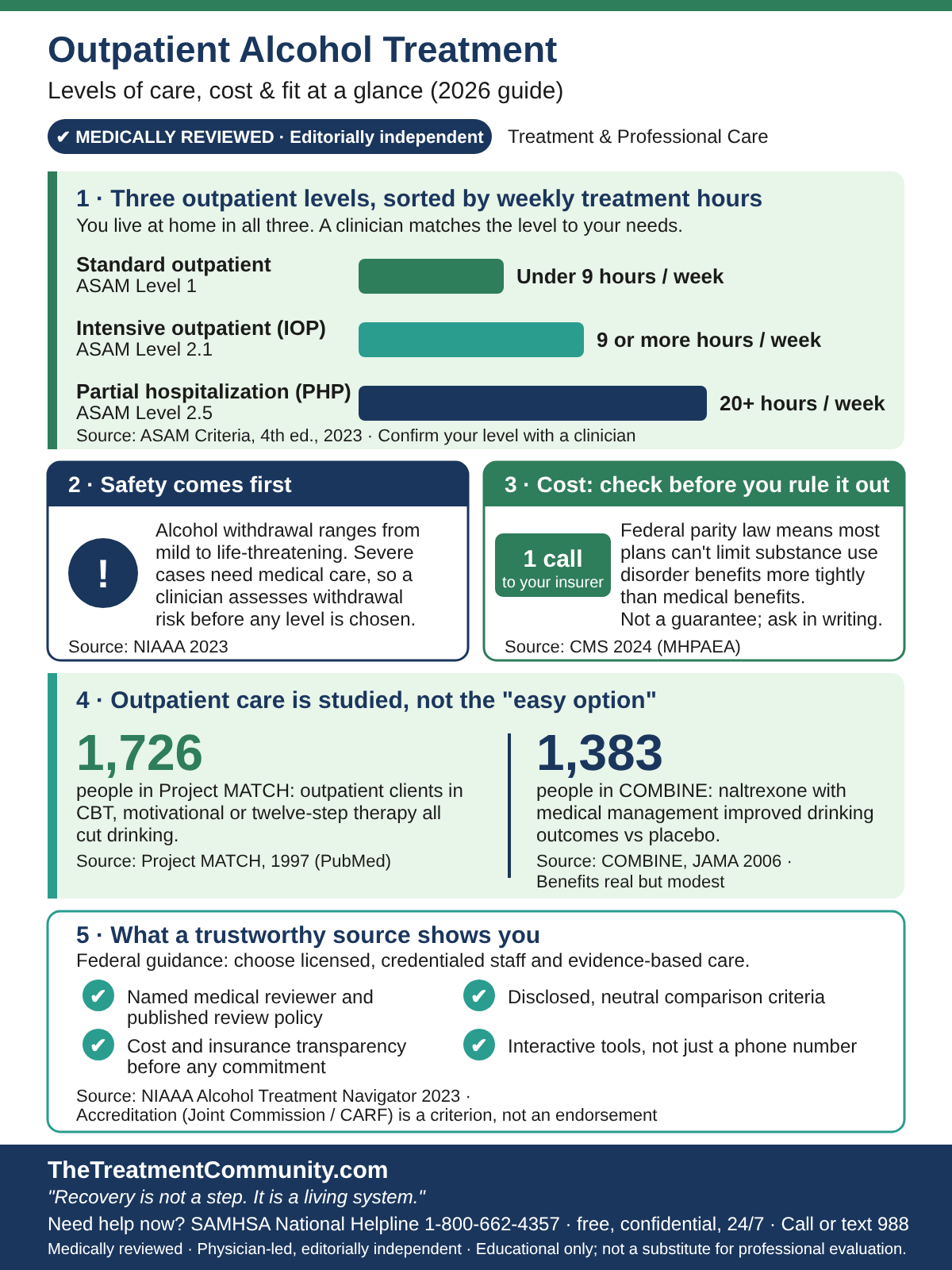
- The ASAM Criteria sort outpatient care by weekly treatment hours: standard outpatient under 9, intensive outpatient (IOP) 9 or more, partial hospitalization (PHP) 20 or more.
- Federal parity law means many health plans must cover substance use disorder benefits no more restrictively than medical benefits. One call to your insurer confirms your plan.
- Alcohol withdrawal can be medically serious. A clinician assesses withdrawal risk before any outpatient level is chosen.
- Large trials show FDA-approved medications and structured therapies improve drinking outcomes in outpatient settings. Benefits are real but modest.
- Program length varies by level and progress. Continuing care is usually measured in months, not weeks.
Table of Contents
Picture a week from now: you know the difference between standard outpatient, intensive outpatient and partial hospitalization, you have checked what your insurance may cover, and you have a short list of questions for a provider. This guide gets you there, calmly and without judgment. It covers outpatient treatment for alcohol use disorder (AUD), not physical or cardiac rehabilitation, and it is published within The Restoration Ecosystem™ under Treatment & Professional Care, TTC’s physician-designed recovery system.
Outpatient Treatment at a Glance: Is It Right for You?
Outpatient treatment is one level within the alcohol treatment continuum, not something separate from “treatment.” You attend scheduled sessions at a clinic or online and return home afterward. That continuum of care runs from standard outpatient through intensive outpatient and partial hospitalization to residential and inpatient care, and a clinician matches the level to your needs.1
There are three types of outpatient treatment. The main visible difference is time per week:
- Standard outpatient (ASAM Level 1): fewer than 9 treatment hours per week for adults.
- Intensive outpatient program, IOP (ASAM Level 2.1): 9 or more hours per week.
- Partial hospitalization program, PHP (ASAM Level 2.5): 20 or more hours per week.1
The NIAAA Alcohol Treatment Navigator stresses that treatment for alcohol problems is not one-size-fits-all, which is why comparing levels matters more than picking the first program you find.2 If you want a starting point before you call anyone, our tools hub is a free, private place to begin.
Check which outpatient level of care may fit you, free and private. (Not a substitute for professional evaluation. Our dedicated level-of-care tool is in development; the Tools hub lists what is live today.)
Find an Outpatient Program Near You
Local search results for outpatient alcohol treatment programs are often facility-owned pages. TTC’s directory is different: no program pays for ranking, and every listing sits beside the same disclosed comparison criteria so you can judge for yourself. We look at licensed, credentialed staff; evidence-based care such as CBT and medication options; accreditation by the Joint Commission or CARF; cost transparency; and a written aftercare plan.
Browse outpatient programs by location, with our disclosed comparison criteria alongside. FTC disclosure: TTC may receive referral fees from some listed programs; this never affects our physician-reviewed guidance or listing order. You can also use Find Treatment to narrow by level of care.
Outpatient Levels of Care: Standard, IOP, and PHP
The three outpatient levels are standard outpatient (under 9 hours a week), intensive outpatient (9 or more hours) and partial hospitalization (20 or more hours), as defined by the ASAM Criteria.1 Beyond them sit residential and inpatient care. Clinicians match the level to withdrawal risk, co-occurring conditions (a mental health condition alongside AUD), home environment and how well earlier care has worked.
The plain difference between outpatient and inpatient treatment is where you sleep. In all three types of outpatient treatment you go home after sessions; in inpatient or residential care you stay on site around the clock. Each level has its own TTC guide. Start with the one that sounds closest to your situation.
Standard Outpatient Treatment
Usually one to a few sessions a week: individual counseling, group therapy, and medication follow-up if prescribed. Often used by people with a stable home, work or school commitments, and no significant withdrawal risk, or as a step down after a more intensive level.
Intensive Outpatient (IOP)
An intensive outpatient program (IOP) typically runs several three-hour blocks a week, with evening and virtual IOP options common. IOP provides more structure than standard outpatient while still letting you sleep at home and, for many people, keep working.
Partial Hospitalization (PHP)
A partial hospitalization program (PHP) is the most intensive outpatient level, often five or six hours a day on weekdays, with closer medical and psychiatric monitoring. PHP suits people who need daily support but have a safe place to return to each night. A dedicated TTC guide to PHP is coming; for now, the IOP and inpatient guides cover the levels on either side of it.
Residential and Inpatient Care
Residential treatment and inpatient care mean twenty-four-hour care in a facility. That is the core difference between outpatient and inpatient care. A clinician may recommend this level when withdrawal risk is high, when the home environment makes recovery hard, or when outpatient care has not been enough.
What Outpatient Treatment Costs and How Insurance Works
Outpatient care generally costs less than residential care because you are not paying for a bed or round-the-clock staffing. Standard outpatient costs less than IOP, which costs less than PHP. Exact prices vary by region, program length, and what is included. Our alcohol treatment cost guide carries dated price ranges by level of care, so this hub does not repeat figures that can go stale.
“I can’t afford it, so there’s no point looking.” Before ruling anything out on cost, two things are worth knowing. First, the Mental Health Parity and Addiction Equity Act prevents most group health plans and insurers from applying less favorable limits to substance use disorder benefits than to medical benefits.3 Copays, coinsurance and visit limits for these benefits cannot be more restrictive than those for comparable medical care.4 That is not a coverage guarantee, but it means coverage often exists. Second, sliding-scale (fees set by income), state-funded and Medicaid-covered outpatient programs exist; the SAMHSA helpline can point you to them.
Your outpatient treatment cost with insurance comes down to a few plan details, and a single call to the number on your insurance card can answer most of them. Worth asking: Is outpatient alcohol treatment covered? Which levels (standard, IOP, PHP)? Is the program in-network (contracted with your plan) or out-of-network? Is prior authorization (your insurer’s advance approval) required? Can you send the answer in writing? Once you have those answers, your real outpatient treatment cost with insurance is a known number rather than a fear.
Verify your insurance benefits for outpatient treatment before you decide anything. FTC disclosure: TTC may receive compensation from insurance-verification partners; this never affects our physician-reviewed guidance. Plan-specific guides: Aetna, Blue Cross, Cigna.
Who Outpatient Treatment Is (and Isn’t) Right For
Choosing outpatient care is a medical decision, not a verdict on your character. As NIAAA puts it:
“Alcohol use disorder (AUD) is a medical condition characterized by an impaired ability to stop or control alcohol use despite adverse social, occupational, or health consequences.”
In general, outpatient care tends to fit people who have a stable, reasonably supportive place to live, can attend sessions reliably, are not at significant risk of severe withdrawal, and have any co-occurring mental health conditions under some management. It tends to fit less well when any of those pieces is missing.
“Isn’t outpatient the easy option?” Level of care is matched to need, not to how serious you are. In Project MATCH, a trial of 1,726 people, outpatient clients receiving cognitive behavioral therapy, motivational enhancement, or twelve-step facilitation all showed substantial reductions in drinking.6 Outcomes depend on fit and on staying engaged.
- Have you had shaking, sweating, or confusion when you stop drinking? → Talk to a clinician about withdrawal risk first.
- Is there a safe, supportive place to return to each night? → If not, discuss residential options with a clinician.
- Can you attend several sessions a week? → Discuss IOP or standard outpatient with a clinician.
When Outpatient May Not Be Enough: Medically Supervised Withdrawal and Higher Levels of Care
Alcohol withdrawal ranges from mild to life-threatening. Severe cases can involve seizures or delirium tremens and require medical care.7 This is why clinicians assess withdrawal risk before recommending any outpatient level, and why some people begin with medically supervised withdrawal or inpatient care and step down to outpatient afterward.
How withdrawal unfolds varies widely from person to person. There is no universal timeline, and this page does not offer one or any instructions for managing symptoms at home. If you have had withdrawal symptoms before, drink heavily every day, or have other medical conditions, a clinician can tell you whether a supervised setting is the safer starting point.
If someone is having a seizure, is confused, or cannot be woken, call 911. For free, confidential guidance any hour, the SAMHSA National Helpline is 1-800-662-4357, available 24 hours a day, 365 days a year, in English and Spanish.8 For emotional crisis, call or text 988.
What Happens in an Outpatient Program
An outpatient program usually starts with an intake assessment, then a plan built from individual counseling, group therapy, cognitive behavioral therapy (CBT, a structured talk therapy that works on the thoughts and habits around drinking) and motivational interviewing (a counseling style that helps you sort out your own reasons to change). Family sessions may be offered. A prescriber may discuss FDA-approved medications for alcohol use disorder. Sessions fit around work, with evening and telehealth options at many programs.
Medication options. Three FDA-approved medications exist for AUD: naltrexone, acamprosate and disulfiram. In the COMBINE trial of 1,383 people, naltrexone with medical management improved drinking outcomes in an outpatient setting compared with placebo.9 A 2014 meta-analysis of outpatient studies found both naltrexone and acamprosate reduced return to drinking.10 Which medication, if any, is right for you is a decision for you and your prescriber; this page does not cover dosing. Our medication-assisted treatment guide explains each option.
Virtual care. Online outpatient alcohol treatment is now widely available. NIAAA reports that telehealth treatment for AUD can reduce drinking and appeals to people less inclined to attend in person.11 A randomized trial found digital CBT worked both on its own and as an add-on to standard outpatient treatment.12
Work. Outpatient programs are built for people who keep daily responsibilities. For eligible employees, the Family and Medical Leave Act may protect job-related leave for treatment.13 Details depend on your employer and situation; HR or an employment attorney can confirm, since this is general information, not legal advice.
How Long Outpatient Treatment Lasts
How long outpatient care lasts varies by level and by your progress. IOP and PHP phases are often measured in weeks, standard outpatient in months, with the schedule set by your clinician and treatment plan rather than a fixed calendar. Individual experiences differ, and no timeline applies to everyone.
NIAAA describes treatment and continuing care as measured in months and sometimes years, with recovery marked by gains in physical health, mental health and relationships over time.14 Staying engaged and stepping down gradually, rather than stopping abruptly, is part of how outpatient care is designed.
How to Choose a Program: Questions to Ask Before You Enroll
A short list of questions to ask an outpatient treatment center puts you in control of the conversation. This ask-first checklist reflects the same criteria we disclose in our directory:
- What treatment approaches do you use, and are they evidence-based (CBT, motivational interviewing, medication options)?
- Who provides care, and what are their licenses and credentials?
- Is the program accredited by the Joint Commission or CARF? (A quality criterion, not an endorsement of any facility.)
- What does the quoted price include, and what is billed separately?
- Do you verify insurance and handle prior authorization, and will you confirm coverage in writing?
- What does aftercare look like once the program ends?
- Are evening or telehealth sessions available?
- How are my records protected?
On the last question: federal rules under 42 CFR Part 2 generally restrict disclosure of substance use treatment records without your consent, with limited exceptions.15 This is general information rather than legal advice; our Confidential Care page goes further.
- Named medical reviewer and published review policy
- Cost and insurance transparency before any commitment
- Disclosed, neutral comparison criteria for every listing
- Interactive tools instead of a single phone number
Want the checklist and our free recovery wellness guide by email? No sales calls, no facility referrals — unsubscribe any time.
We never share your email with treatment providers.For Families: Supporting a Loved One in Outpatient Care
If you are reading this for someone else, you are probably tired, and you may feel guilt that is not yours to carry. Family members are a significant source of support in recovery, and the strain of AUD on families is real and well documented.16 Many outpatient programs include family therapy, and CRAFT-based programs (a structured approach that teaches supporters how to encourage treatment without confrontation) exist specifically for you. You have your own parallel pathway in Family Therapy & Support: start at the Family Alcohol Support Hub or Supporter Resources.
Life After the Program: Continuing Care and Staying on Track
Finishing an outpatient program is a step down within the continuum, not an exit from support. Continuing care may include less frequent counseling, medication follow-up, peer recovery groups and relapse-prevention skills; a meta-analysis found CBT-based approaches show moderate, significant effects compared with minimal treatment.17 Sleep, nutrition and stress management belong here too, which is what our Recovery & Wellness hub covers. The Sobriety Calculator is a simple way to mark progress.
Frequently Asked Questions
What happens during outpatient rehab?
An outpatient treatment program begins with an assessment, then scheduled sessions: individual counseling, group therapy, CBT or motivational interviewing, and sometimes family sessions. A prescriber may discuss FDA-approved medications. You return home after each session, and many programs offer evening or telehealth schedules.
How long is outpatient rehab?
Length varies by level and progress. IOP and PHP phases are often measured in weeks, standard outpatient in months, with continuing care sometimes lasting longer.14 Your clinician sets the schedule based on your plan. There is no universal timeline.
What are the three types of rehab?
Within outpatient care, the three levels are standard outpatient (under 9 hours a week), intensive outpatient (9 or more hours) and partial hospitalization (20 or more hours), per the ASAM Criteria.1 Residential and inpatient treatment sit above them on the continuum.
Is outpatient the same as rehab?
Outpatient treatment is one level of alcohol treatment, not a separate thing from it. “Treatment” covers the full continuum from standard outpatient through IOP, PHP and residential or inpatient care. A clinician matches the level to withdrawal risk, co-occurring conditions and home environment.1
Does insurance cover outpatient rehab?
Often, yes. Federal parity law prevents most group plans and insurers from limiting substance use disorder benefits more restrictively than medical benefits.3 Coverage, in-network status and prior authorization vary by plan, so a call to your insurer, with the answer in writing, is the reliable check.
Can you work while in outpatient treatment?
Many people do. Outpatient programs are designed around daily responsibilities, and evening and virtual sessions are common. For eligible employees, FMLA may protect leave for treatment;13 HR or an employment attorney can confirm what applies to you.
Your Next Step: Check Your Level of Care and Find a Program
You do not have to decide everything today. One small step is enough: check which level of care may fit you, see outpatient programs near you, or verify your insurance benefits. Each is free and private, and none of them commits you to anything. Start with Treatment & Professional Care: medically reviewed guidance, no facility affiliation.
At TTC, “Recovery is not a step. It is a living system.” This guide is medically reviewed by Dr. Adiele Onyeze, MD., and produced by a physician-led, editorially independent team. Beneath The Restoration Ecosystem sits Adaptive Recovery Intelligence™, the continuous adaptation cycle that helps our guidance keep pace with where you actually are.