
How to Verify Insurance for Rehab: Questions to Ask Before You Commit
Written by TTC Editorial Team · Medical Reviewer: Dr. Adiele Onyeze, MD · TTC is physician-led and editorially independent: not owned by, funded by, or affiliated with any treatment center, insurer, or pharmaceutical company. This page contains one disclosed verification-partner link; see our FTC Disclosure.
What if checking your insurance for a treatment program didn’t mean you had to be ready to start one? Looking into coverage is administrative, not a decision. This guide covers what a benefits check is, exactly what to ask your insurer, and what to do if the answer is “no.”
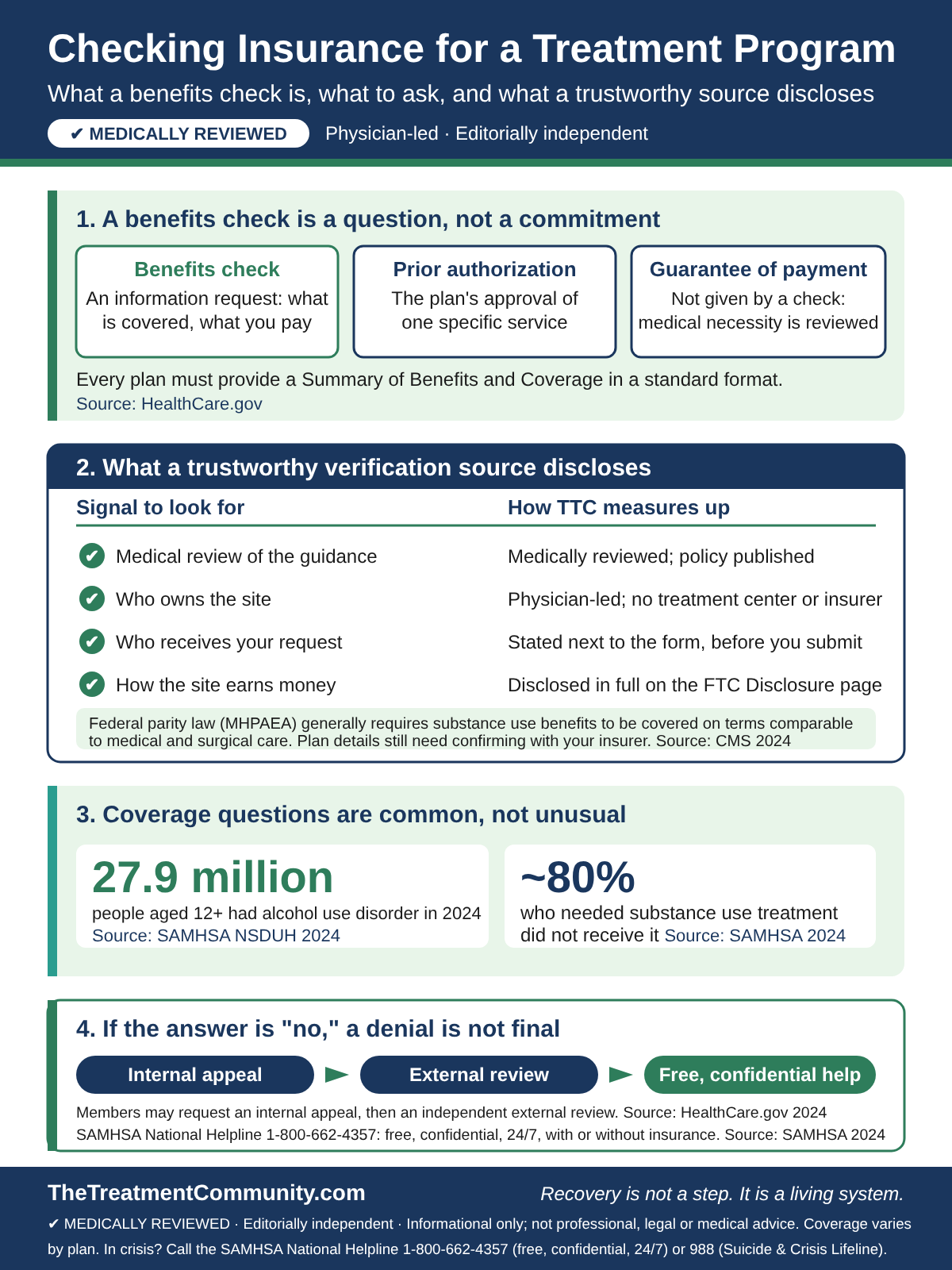
Verifying insurance for a treatment program means asking your health plan, usually by calling member services, whether a program is in-network, which levels of care are covered, and what you would pay. It commits you to nothing, and it is not a guarantee of payment, because insurers review medical necessity separately. One call usually answers most questions.
- Federal parity law generally requires plans that cover substance use benefits to apply limits no more restrictive than those for medical or surgical care.
- Three identifiers (member ID, group number, and plan type) are usually enough to get answers in a single call.
- Checking a family member’s coverage generally requires that you be the policyholder or have the member’s written authorization.
- A denial is not final: internal appeal and external review rights exist, and free, confidential help is available with or without insurance.
Table of Contents
What It Means to Verify Insurance Before Treatment
A verification of benefits is an information request: you ask your plan what it covers and what you would pay. It is different from prior authorization (also called pre-authorization), which is the plan’s approval of a specific service, and different again from a guarantee of payment. Your plan’s Summary of Benefits and Coverage lists what is covered in a standard format every insurer must provide.[1]
You do not need a diagnosis, or even a decision, to understand your benefits. Learning how to verify insurance benefits for addiction treatment is the same kind of task as checking benefits before a physical. Treating it that way tends to make the call easier.
Why Checking Coverage First Protects You Financially
How much does treatment cost with insurance? Three plan terms decide most of the answer, whether you expect to use health insurance for outpatient alcohol treatment or for a residential stay. Reading them off your Summary of Benefits and Coverage takes about ten minutes and gives you one concrete yearly ceiling.[2]
| Term | What it means for you |
|---|---|
| Deductible | What you pay before the plan starts sharing costs. |
| Copay / coinsurance | Your share per visit or per stay after the deductible. |
| Out-of-pocket maximum | The most you pay in a plan year for covered, in-network care.[2] |
| In-network vs. out-of-network | Out-of-network treatment cost is often higher and may not count toward your maximum. |
Coverage questions are common, not unusual. In 2024, about 27.9 million people aged 12 and older had alcohol use disorder,[3] and roughly 80% of people who needed substance use treatment did not receive it.[4] Cost confusion is one of the barriers people describe. For how much treatment costs with insurance at each level of care, see the alcohol treatment cost guide.
How to Contact Your Insurer and Confirm Your Policy Is Active
To check whether your policy is valid, call the member services number on the back of your insurance card or sign in to the plan’s member portal. Either one confirms whether coverage is active today and when the plan year resets. A missed premium or a lapsed policy can affect eligibility, so this is worth confirming first.
In practice, how to verify insurance benefits for addiction treatment comes down to one free, confidential call that follows a simple sequence:
- Gather your card details and plan documents (see the list below).
- Call member services, or use the portal’s benefits section.
- Ask the checklist questions in the next section.
- Note the answers, the representative’s name, and the call reference number.
- Decide your next step at your own pace.
Many answers come during the same call. Some benefit confirmations take a few business days, and timing varies by plan. A treatment program can also verify benefits for substance use treatment on your behalf, but you are never required to go through a program or a website to learn what your own plan covers.
Questions to Ask Your Insurer
Does insurance cover alcohol treatment? Usually, yes, in some form. Most employer, marketplace, Medicaid, and Medicare plans include substance use disorder benefits, and federal parity law generally requires those benefits to be covered on terms comparable to medical and surgical care.[5] What any plan actually pays depends on your specific plan, network status, and a medical-necessity review, so the answers below have to come from your insurer.
A list to keep beside you:
- Is this specific treatment program in-network with my plan?
- Which levels of care does my plan cover, such as detox, inpatient treatment, intensive outpatient, outpatient treatment, and medication-assisted treatment?
- Does my plan require prior authorization (sometimes called pre-certification), and who requests it?
- How much of my deductible remains this year?
- What is my out-of-pocket maximum, and how much have I already met?
- What are my copays or coinsurance for each level of care?
- Is there a limit on covered days or sessions?
- Does the plan cover telehealth or digital components of care?
- How will Explanation of Benefits notices (the statements a plan sends after processing a claim) be delivered, and can I request confidential communications?
- Can I get these answers in writing or by secure message?
On question 2: insurers typically evaluate coverage against the level of care a clinician recommends, often described using the ASAM levels of care, a continuum from outpatient to residential. They also apply the plan’s medical-necessity criteria, meaning its standards for whether a service is clinically needed. That is why a professional assessment usually comes before authorization. This page does not determine what level of care is right for anyone; a licensed clinician does. Question 2 also settles the practical versions of this, such as “can I use health insurance for outpatient alcohol treatment” or whether Medicaid pays for alcohol treatment in your state.
On question 8: NIAAA notes that telehealth options for alcohol treatment can reduce drinking and may suit people who prefer not to attend in person,[6] and a randomized trial found a smartphone-supported continuing-care program was associated with fewer risky drinking days over 12 months.[7] NIAAA’s Alcohol Treatment Navigator offers neutral guidance on evaluating and paying for care if you want to cross-check anything you hear.[8]
Get this checklist by email to review when you’re ready. Unsubscribe anytime. This is a free TTC email; no partner compensation is involved.
Documents and Information to Have Ready
About five minutes of preparation means one call is usually enough. Helpful to have on hand:
- Member ID and group number from your insurance card
- Plan type (HMO, PPO, EPO) and the policyholder’s name and date of birth
- Your Summary of Benefits and Coverage, which plans are required to make available to you[1]
- Any clinician recommendation letter, if one exists
Plan type matters. Employer-sponsored, marketplace, Medicaid, and Medicare plans each have different network rules and authorization steps. If your question is “does Medicaid pay for alcohol treatment,” the answer depends on where you live, because Medicaid alcohol treatment benefits vary by state. If your plan is through a national carrier, our Aetna, Blue Cross, and Cigna coverage guides walk through carrier-specific steps.
Mental Health Parity and Substance Use Coverage Basics
Parity law is the main reason the answer to “does insurance cover alcohol treatment” is usually yes. The Mental Health Parity and Addiction Equity Act (MHPAEA) generally prevents group health plans and insurers that offer mental health and substance use disorder benefits from applying less favorable limits than they apply to medical and surgical benefits.[5] That covers financial requirements such as copays and coinsurance, and treatment limits such as visit caps.[9] Under the Affordable Care Act, substance use disorder services are also an essential health benefit for marketplace and most individual and small-group plans.
This is consumer-level context, not legal advice. Coverage details vary by plan and are confirmed only by your insurer. If you believe a plan is applying unequal limits, or if employment or custody questions arise, a qualified attorney or your state insurance commissioner’s consumer-assistance program can help.
Verifying on Behalf of a Family Member
Yes, you can check someone else’s coverage if you are the policyholder or the member gives permission. Otherwise, insurers will generally discuss benefits only with the member or an authorized representative. Asking the plan for its release or authorization form is the usual first step.
Supporting someone through this is real work, and asking about coverage is a practical way to help. Privacy protections apply in both directions: HIPAA limits how health plans and providers use and share health information,[10] and a separate federal rule, 42 CFR Part 2, adds protections for substance use treatment records. Explanation of Benefits notices usually go to the policyholder, so asking about confidential-communications options is reasonable for anyone who wants discretion.
Consent and privacy questions beyond this overview belong with the plan or an attorney. For your own support, the Family Alcohol Support Hub and Supporter Resources are built for people in your position.
What to Do if Insurance Denies or Limits Coverage
A verification is not a guarantee of payment. Denials most often cite medical necessity or network status. Members have the right to request an internal appeal and, if the denial is upheld, an independent external review.[11] State insurance commissioner consumer-assistance programs can explain the process; specific legal questions go to an attorney.
If coverage falls short, some treatment options without insurance, or with limited coverage, that people explore include sliding-scale programs (fees based on income), single-case agreements (a one-time negotiated rate for out-of-network care), payment plans for treatment programs, and HSA or FSA funds. The cost guide describes these in more detail, and the Alcohol Savings Calculator can put spending in perspective.
The SAMHSA National Helpline at 1-800-662-4357 is free, confidential, and available 24/7, and it refers callers to local treatment and support, including people without insurance.[12] FindTreatment.gov lists programs along with the payment options each accepts.[13] If you or someone you know is in crisis, call 1-800-662-4357 or 988.
How TTC’s Insurance Verification Works (and How We Stay Independent)
Many insurance verification websites are lead forms for treatment centers. That caution is reasonable. You can always verify directly with member services at no cost, or call SAMHSA’s helpline.[12] Here is what to look for in any verification source, and how TTC measures up:
| Signal | TTC |
|---|---|
| Medical review of the guidance | Medically reviewed; see our Medical Review & Editorial Policy |
| Who owns the site | Physician-led; not owned by any treatment center, insurer, or pharmaceutical company |
| Who receives your request | Stated next to the form, before you submit |
| How the site earns money | Disclosed in full on our FTC Disclosure page |
When you use TTC’s confidential insurance check, your plan details go to an independent verification partner, not to a treatment program, and nothing is sent until you choose to submit. Disclosure: TTC may receive compensation when you use a verification partner; this never affects our physician-reviewed guidance.
Try our free coverage check at your own pace, no commitment required.
Disclosure: TTC may receive compensation when you use a verification partner. This never affects our medically reviewed guidance. See our FTC Disclosure.
Prefer to look for programs yourself? SAMHSA’s FindTreatment.gov locator lets you filter programs by payment options, and Confidential Care covers discreet options.
Frequently Asked Questions
How do I verify insurance coverage for rehab?
Call the member services number on your insurance card, or sign in to your member portal, and ask whether a specific treatment program is in-network, which levels of care are covered, whether pre-authorization is required, and what your remaining deductible and out-of-pocket maximum are. A treatment program can also run this check, but you are never required to use one.
Does verifying insurance commit me to treatment?
No. A benefits check is an information request. It does not enroll you in anything, and it does not oblige you to start a program. Your plan’s Summary of Benefits and Coverage and member services can answer questions about network status and authorization without any admission decision on your part.[1]
How long does insurance verification take?
Many questions are answered during the first call. Some confirmations, especially pre-authorization decisions, take a few business days. Timing varies by plan and by the level of care involved, so asking the representative for an expected timeframe and a reference number is useful.
Is insurance verification confidential?
Health plans are bound by HIPAA, which limits how your health information is used and shared,[10] and substance use treatment records carry added protection under 42 CFR Part 2. Explanation of Benefits notices usually go to the policyholder, so ask your plan about confidential-communications options if that matters to you.
What can I do if my insurer denies coverage for treatment?
You can request an internal appeal, and if the denial is upheld, an external review by an independent reviewer.[11] Your state insurance commissioner’s consumer-assistance program can explain the steps. For legal questions, a qualified attorney is the right resource. Free, confidential referrals are available through the SAMHSA National Helpline at 1-800-662-4357.[12]
Your Next Step Within The Restoration Ecosystem™
Checking coverage is the financial-access step of Treatment & Professional Care within The Restoration Ecosystem™, TTC’s physician-designed recovery system. Recovery is not a step. It is a living system. When you’re ready, explore the Treatment Guides hub, or the Family Alcohol Support Hub if you are reading on behalf of someone else. This content is for informational purposes and is not a substitute for professional evaluation. For immediate help, see our Crisis Resources.
Need to talk to someone now?
Free, confidential, and available 24/7, with or without insurance. Calling commits you to nothing.
More crisis resourcesSources
References (13)
- HealthCare.gov. (n.d.). Summary of Benefits and Coverage (SBC). https://www.healthcare.gov/health-care-law-protections/summary-of-benefits-and-coverage/
- HealthCare.gov. (n.d.). Glossary: Out-of-pocket maximum/limit. https://www.healthcare.gov/glossary/out-of-pocket-maximum-limit/
- Substance Abuse and Mental Health Services Administration. (2025). 2024 National Survey on Drug Use and Health: Annual national report. https://www.samhsa.gov/data/sites/default/files/reports/rpt56287/2024-nsduh-annual-national-html-071425-edited/2024-nsduh-annual-national.htm
- Substance Abuse and Mental Health Services Administration. (2025). Release of the 2024 NSDUH: Treatment gap. https://www.samhsa.gov/blog/release-2024-nsduh-leveraging-latest-substance-use-mental-health-data-make-america-healthy-again
- Centers for Medicare & Medicaid Services. (2024). The Mental Health Parity and Addiction Equity Act (MHPAEA). https://www.cms.gov/marketplace/private-health-insurance/mental-health-parity-addiction-equity
- National Institute on Alcohol Abuse and Alcoholism. (2024). Telehealth options for alcohol treatment. https://www.niaaa.nih.gov/publications/telehealth-options-alcohol-treatment
- Gustafson, D. H., McTavish, F. M., Chih, M.-Y., et al. (2014). A smartphone application to support recovery from alcoholism: A randomized clinical trial. JAMA Psychiatry, 71(5), 566–572. https://doi.org/10.1001/jamapsychiatry.2013.4524
- National Institute on Alcohol Abuse and Alcoholism. (2023). NIAAA Alcohol Treatment Navigator. https://alcoholtreatment.niaaa.nih.gov/
- U.S. Department of Labor. (2024). Mental health and substance use disorder parity: Federal requirements. https://www.dol.gov/agencies/ebsa/laws-and-regulations/laws/mental-health-and-substance-use-disorder-parity
- U.S. Department of Health and Human Services. (n.d.). HIPAA for individuals. https://www.hhs.gov/hipaa/for-individuals/index.html
- HealthCare.gov. (2024). How to appeal an insurance company decision. https://www.healthcare.gov/appeal-insurance-company-decision/
- Substance Abuse and Mental Health Services Administration. (2024). SAMHSA’s National Helpline. https://www.samhsa.gov/find-help/national-helpline
- Substance Abuse and Mental Health Services Administration. (n.d.). FindTreatment.gov. https://findtreatment.gov/