
The Rehab Cost Guide: What Alcohol Treatment Costs and How to Pay
Most people only learn what treatment costs when they are already on the phone. This free guide gives you the sourced price ranges, the coverage rules in plain words, and a worksheet to fill in before you call.
Get the free guide- Editorially Independent
- Physician-Led, Reader-First
What “Medically Reviewed” means
Pages carrying the Medically Reviewed badge have been reviewed for accuracy by credentialed medical professionals and specialists. The reviewer of record and the review dates appear at the bottom of the page.
The Treatment Community is physician-led and editorially independent. We fact-check against strict guidelines and cite only credible sources — peer-reviewed research and government health agencies — and re-review each page on a six-month cadence, or sooner when clinical guidance changes.
If you or someone you love needs help right now, call or text 988 (Suicide & Crisis Lifeline), or call the SAMHSA National Helpline at 1-800-662-4357 (free, confidential, 24/7). In an emergency, call 911.
- Sourced cost figures for hospital and residential care, with the year on every number, and the cost-sharing rules for day programs and outpatient care.
- What your plan must cover under federal law, and what “covered” does not promise.
- The one-call benefits worksheet: seven questions, a script, and a place to write the answers.
You’ll get the guide as a PDF and a web link, then five short emails over two weeks with the worksheet walkthrough and your options. Unsubscribe with one click, any time. We never sell your information. Asking for this guide tells us you are interested in treatment costs; we treat that as health-related information and use it only to send what you asked for. Privacy Policy
This guide is educational. It is not insurance or legal advice, and no number in it is a quote.
What’s inside
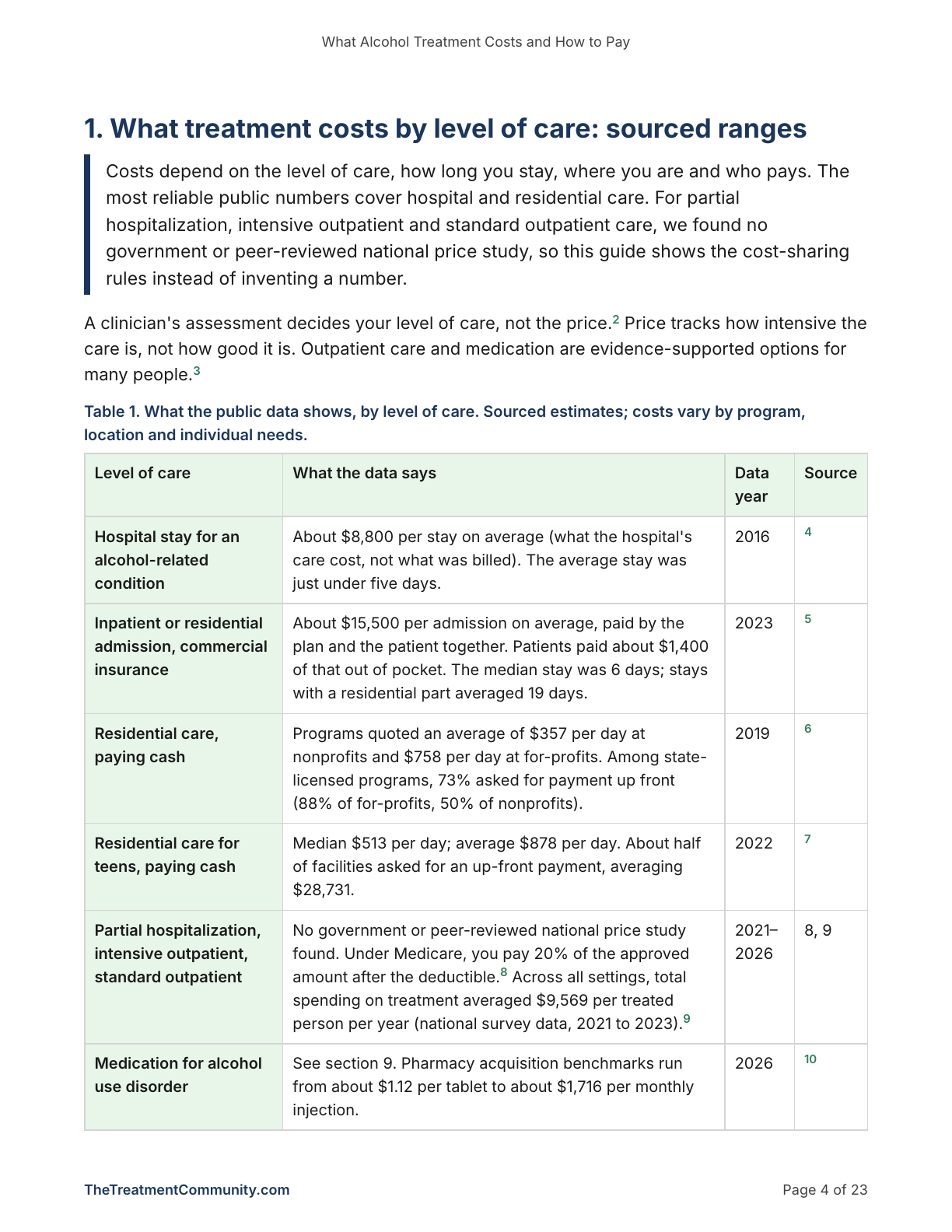
- A cost table by level of care, built only from public studies and government rates, each with its data year (and an honest “no national price study” where none exists).
- The six things that move the price, from length of stay to medication.
- The law in plain words: essential health benefits, the out-of-pocket maximum, metal tiers and parity.
- The one-call benefits worksheet and a script for the member-services line.
- Questions to ask the program about total cost, deposits and refunds, plus your right to a written Good Faith Estimate when you pay cash.
- A 2026 quick reference for Medicare, Medicaid, TRICARE and VA.
- What to do with no coverage: state-funded programs, sliding-scale fees, Medicaid and the free federal locator.
- What the approved medications cost, and a one-page pre-admission checklist.

Who it’s for
- You are deciding this week, probably on your phone, and you want the numbers without the sales pitch.
- You are choosing for someone you love and need to know what to ask before you call.
- You have no insurance and want to know your real options.
Who wrote it
Physician-led and editorially independent. Written by The Treatment Community Editorial Team and medically reviewed by Adiele Onyeze, MD on .
Every number comes from a public source: CMS and Medicare.gov, Medicaid.gov, TRICARE, VA, SAMHSA, NIAAA, the Department of Labor, and peer-reviewed cost studies. No treatment center’s pricing page is used, and no treatment center pays to appear in the guide. We don’t sell your email.
Three ways to pay

Frequently asked questions
Is this a quote?
No. Every number in the guide is a sourced range or a government rate with its year. A program must confirm your cost in writing before admission.
Do I have to give my email to get help?
No. The crisis lines, the free cost article and the coverage-check page are open to everyone, and they are linked on this page.
Will you sell my email or share that I asked about treatment?
No. We treat your request as health-related information and use it only to send what you asked for. No treatment center pays us, and we never sell your information.
What if I have no insurance?
The guide covers state-funded programs, sliding-scale fees, how to check whether you qualify for Medicaid, and the free federal treatment locator.
Does insurance have to cover alcohol treatment?
Marketplace plans and other non-grandfathered individual and small-group plans must cover substance use disorder services as an essential health benefit, and parity law limits stricter rules in plans that cover them. “Covered” is not “free,” so the guide shows what to ask your plan.
How current are the numbers?
Each figure carries the year its data was collected, and the guide states the date we last checked every source. We review the figures each quarter.
Ready for the numbers?Get the guide, the worksheet and the checklist in one PDF.
Not ready yet? Take your time. The crisis lines and the free article will still be here.